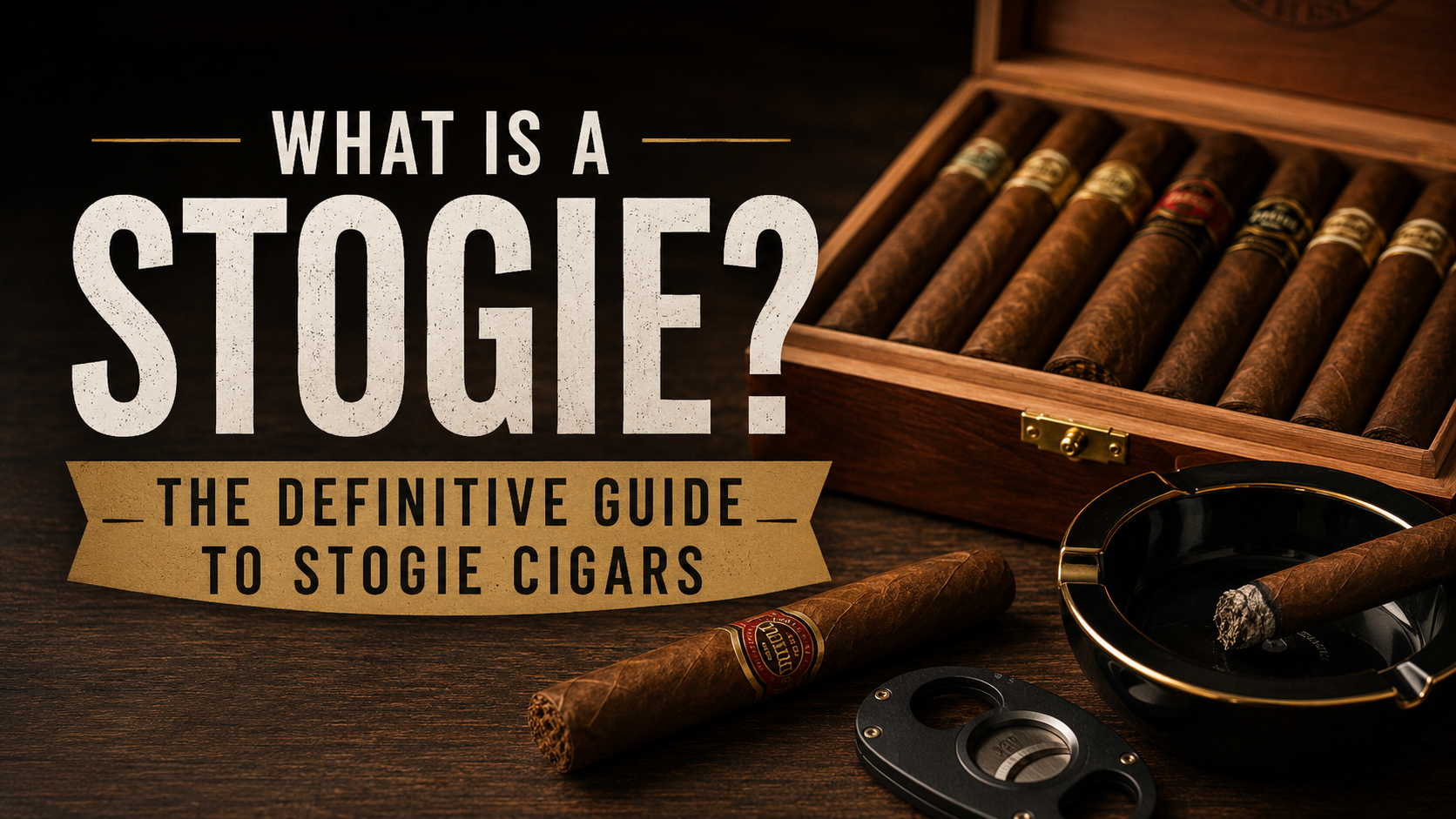
Everyone’s heard the word. You picture a grizzled cowboy with a cigar clamped between his teeth, or a backroom politician shrouded in smoke. The word *stogie* is baked into American culture — but most people who use it have no idea where it came from, or exactly what it means.
This guide covers it all: the stogie meaning, its origins in the American frontier, the different types of stogie cigars you’ll encounter today, and how to choose one — whether you’re completely new to cigars or just looking for a casual smoke without spending a fortune.
—
What Is a Stogie? The Short Answer
A **stogie** (also spelled *stogy*) is a slang term for a cigar. In everyday use, it can mean just about any cigar — but it carries an implied informality. The word suggests something approachable, unpretentious, and casual. When someone says “grab a stogie,” they’re not talking about a $30 hand-rolled stick from a humidity-controlled humidor. They’re talking about a porch smoke.
That said, both uses are technically correct. Merriam-Webster defines stogie as *”a long slender cigar,”* but also accepts it as a general synonym for cigar. So calling any cigar a stogie isn’t wrong — it just communicates something about the vibe.
The simplest definition: A stogie is any cigar, especially one that’s long, thin, affordable, or smoked casually.
—
Stogie Meaning: Where Does the Word Come From?
To understand the stogie meaning, you need to go back to 18th-century Pennsylvania.
The Conestoga wagon — that iconic canvas-covered freight vehicle — was manufactured primarily near Conestoga, a community in Lancaster County, Pennsylvania. These wagons were the workhorses of early American commerce and westward expansion. The men who drove them were called teamsters, and they spent long days on rough roads hauling goods across the frontier.
To pass the time, they smoked. Their cigars of choice were long, thin, inexpensive, and practical — the kind of cigar that didn’t require careful storage and wouldn’t crumble after a day bouncing down a dirt trail.
Over time, those cigars picked up the name of the wagons. *Stogie* — shortened from *Conestoga* — first appeared in print around 1835 as an adjective meaning “rough” or “coarse,” initially applied to the thick, durable boots that teamsters wore. By 1861, it was being used to describe their cigars, too. By 1869, *stogie* had entered common American usage as a noun meaning a long, cheap cigar.
Lancaster County, incidentally, was also home to one of the earliest and most productive cigar-manufacturing regions in the country at the time — so the geography makes sense.
Stogie = Conestoga → wagon drivers → the cigars they smoked → any cigar.
—
Is a Stogie a Cigar?
Yes — all stogies are cigars, but not all cigars are stogies.
Think of it like sparkling wine and champagne. Champagne is sparkling wine, but calling a bottle of Cristal “sparkling wine” misses the point. In the same way, calling a Liga Privada No. 9 a “stogie” is technically accurate but tonally off. The term doesn’t honor what that cigar represents.
For everyday smokes, budget picks, machine-made sticks, or casual occasions — “stogie” fits perfectly.
—
Types of Stogie Cigars
When people reach for something they’d call a stogie, they’re typically choosing from one of these styles:
The classic long stogie
Long (6–8 inches), thin (ring gauge 32–38), and straight. This is the closest modern equivalent to what Conestoga teamsters actually smoked. Mild to medium strength, fast-burning, and no-fuss. Perfect for when you want a smoke but don’t want to commit to an hour-long session.
Italian-style dry-cured cigars
Brands like Toscano, Toscanello, and De Nobili are the spiritual descendants of the original stogie. They’re fire-cured or dry-cured rather than fermented, which gives them a distinctive sharp, rustic character. Often smoked halfway and extinguished, then re-lit. These are an acquired taste — not the place to start if you’re brand new — but beloved by those who appreciate their old-world character.
Machine-made budget cigars
The contemporary stogie. Consistent, widely available, and inexpensive. These range from gas-station-counter smokes to surprisingly solid options in the $3–8 range. If someone offers you a stogie at a backyard barbecue, this is probably what they mean. [See our budget cigar reviews →]
Cigarillos
Smaller than a full-size cigar — usually under 4 inches — and often machine-made. Frequently lumped under the stogie umbrella in casual conversation. Good entry point for beginners who want to try a cigar without committing to a 45-minute smoke.
Cheroots
An old-world style with both ends open — no cap, no tapered head. Associated with Southeast Asia and historically with the American South. Often classed as stogies in the broader sense. If you’ve seen old Western films where a character has a stubby, straight-cut cigar in his mouth, that’s usually a cheroot.
—
How to Choose a Stogie
If you’re new to cigars, a stogie-style smoke is one of the best places to start. Low price, low stakes, and forgiving if you make a mistake. Here’s what to pay attention to:
Strength. Most classic stogies are mild to medium. If you’ve never smoked before, start on the milder end. A full-bodied cigar on an empty stomach can make you feel sick — not the experience you’re after. Our beginner cigar guide breaks this down in more detail.
Size. Thinner cigars burn hotter and faster. Thicker ones (higher ring gauge) burn cooler and give you more time to enjoy the smoke. For a classic stogie, a corona or lancero vitola — long and thin — is the traditional shape.
Wrapper color. This is the quickest shorthand for flavor profile. Light (claro) wrappers tend to be mild and slightly grassy. Medium brown (colorado) is versatile and the most common. Dark (maduro) wrappers are fermented longer, which often makes them sweeter and fuller-bodied, despite looking more intense.
Construction. Before lighting, gently squeeze the cigar along its length. It should feel firm and consistent — no soft spots, which indicate air pockets, and no hard lumps, which mean uneven filling. A poorly constructed cigar draws badly and burns unevenly.
Budget. The whole spirit of a stogie is accessibility. You don’t need to spend more than $5–10 for a solid casual smoke. Spending more doesn’t hurt, but it’s not required to have a good time.
—
Stogies in American Culture
The stogie’s cultural staying power comes from its democratic character. While Cuban cigars became symbols of wealth and exclusivity, the stogie was the cigar of wagon drivers, coal miners, baseball managers, and small-town politicians. It showed up in Mark Twain’s writing, in Groucho Marx’s act, and in the mouths of generals on the front lines.
That working-class DNA never entirely washed out. Even today, the word *stogie* signals approachability. It takes the pretension out of cigar smoking. When someone says “come have a stogie with me,” they’re inviting you to relax — not to perform.
It’s worth noting that premium cigar companies almost universally avoid the word. The connotation of cheapness makes “stogie” commercially undesirable if you’re selling $25+ cigars. That’s exactly why it remains so useful for everyone else: it tells you this is going to be an easy, unpretentious smoke.
—
Frequently Asked Questions About Stogies
Is “stogie” an insult?
Context-dependent. Calling a friend’s prized Davidoff a “stogie” might land as mildly dismissive — not because the word is negative, but because it doesn’t acknowledge the cigar’s quality. For everyday smokes, the word is completely neutral, even affectionate.
Is it spelled stogie or stogy?
Both are correct. Merriam-Webster accepts both. “Stogie” is far more common in modern writing and what most people search for online.
Are stogies lower quality than cigars?
Not necessarily — the term has evolved past its origin as a descriptor for cheap smokes. Traditional stogie-style cigars are genuinely different from premium hand-rolled cigars, but neither is objectively better. They serve different occasions.
What’s the difference between a stogie and a cigarillo?
Mostly size. A cigarillo is smaller — usually under 4 inches, thin ring gauge. A stogie can refer to any cigar, but often implies something larger and more rustic than a cigarillo.
Can beginners smoke stogies?
Absolutely — they’re one of the better starting points. Stick to a mild machine-made or a shorter cigarillo, don’t inhale, and pair it with something to drink. Our beginner’s guide has everything you need to know before your first smoke.
—
The Bottom Line
A stogie is a cigar — specifically one with a certain blue-collar, no-frills spirit that traces back to 19th-century Pennsylvania wagon drivers. The word has stretched over time to cover almost any cigar in casual conversation, but its cultural DNA is still intact: a stogie is an accessible smoke, a shared ritual, something you light up without overthinking it.
If you’re ready to pick one out, start with our cigar reviews — we cover everything from the best budget stogies to hand-rolled options worth stepping up to when you’re ready.
-
Draw
-
Flavor
-
Construction